

Introduction
Hearing is one of the first senses a child uses to connect with the world around them. Long before they can speak, children are listening — to voices, to sounds, to the rhythm of language. When that ability is affected, even partially, the impact on a child’s development can be far-reaching and long-lasting.
Hearing loss in children is more common than most parents realise. In Pakistan, where newborn hearing screening programmes are not yet universally available, many cases go undetected for months or even years. By the time a child is diagnosed, crucial developmental windows may have already passed.
This guide answers every question parents commonly ask about hearing loss in children — from the earliest signs to testing, treatment and where to find the right support in Pakistan.
What Is Hearing Loss in Children?
Hearing loss means that a child cannot hear sounds at the same level as other children their age. It can affect one ear (unilateral) or both ears (bilateral), and it can range from mild to profound.
It is not always obvious. A child with mild hearing loss may seem to hear well in quiet environments but struggle in noisy classrooms or social settings. A child with moderate loss may appear to respond normally to loud sounds but miss much of what is said in everyday conversation.
Hearing loss in children is classified into three main types:
- Conductive hearing loss — caused by problems in the outer or middle ear, such as fluid, infections or structural abnormalities. This type is often treatable.
- Sensorineural hearing loss — caused by damage to the inner ear or auditory nerve. This is typically permanent but manageable with the right support.
- Mixed hearing loss — a combination of both conductive and sensorineural loss.
What Causes Hearing Loss in Children?
Understanding the cause helps determine the most appropriate treatment. Common causes include:
- Genetic factors — hearing loss is hereditary in many cases, even when no family history is obvious
- Infections during pregnancy — rubella, cytomegalovirus (CMV) and toxoplasmosis can affect a baby’s hearing before birth
- Premature birth or low birth weight — these increase the risk of hearing difficulties
- Jaundice at birth — severe neonatal jaundice can damage the auditory nerve
- Ear infections (otitis media) — repeated middle ear infections are one of the most common causes of temporary hearing loss in children
- Meningitis — bacterial meningitis in particular can cause sudden and permanent hearing loss
- Excessive noise exposure — prolonged exposure to loud sounds, including music through earphones, can damage hearing over time
- Certain medications — some antibiotics and chemotherapy drugs can affect hearing
Signs of Hearing Loss in Children — By Age
One of the most important things parents can do is know what to look for at each stage of development.
In Babies (0 to 12 months)
- Does not startle at loud sounds
- Does not turn toward the source of a sound by 6 months
- Does not respond to their name by 8 to 10 months
- Is not babbling or making varied sounds by 12 months
In Toddlers (1 to 3 years)
- Limited vocabulary for their age
- Does not follow simple instructions without seeing your face
- Turns up the volume on TV or videos consistently
- Speaks unclearly and is difficult to understand
- Often says “what?” or asks you to repeat yourself
In School-Age Children (3 years and above)
- Struggles in noisy classrooms or group settings
- Has difficulty learning to read or spell
- Appears inattentive or easily distracted
- Performs inconsistently in school — doing better in quiet one-on-one settings
- Complains of ringing in the ears (tinnitus)
Any of these signs warrants a professional hearing assessment — not a wait-and-see approach.
How Is Hearing Loss Diagnosed in Children?
Diagnosing hearing loss in children requires specialised testing that is appropriate for the child’s age and level of co-operation.
Newborn Hearing Screening
The most effective form of early detection is screening at birth. This involves a quick, painless test called Otoacoustic Emissions (OAE) or Automated Auditory Brainstem Response (AABR), which takes only a few minutes and can be performed while the baby is sleeping.
Behavioural Audiometry
For older infants and toddlers, audiologists use play-based hearing tests that observe a child’s responses to sounds at different frequencies and volumes. These include:
- Visual Reinforcement Audiometry (VRA) — for children aged 6 months to 2.5 years
- Play Audiometry — for children aged 2.5 to 5 years
- Pure Tone Audiometry — for children aged 5 and above who can follow instructions
Additional Tests
- Tympanometry — checks middle ear function and detects fluid or pressure problems
- Auditory Brainstem Response (ABR) — measures how the auditory nerve responds to sound, useful for children who cannot participate in behavioural testing
- Speech Audiometry — assesses how well a child can hear and understand spoken words
Treatment Options for Hearing Loss in Children in Pakistan
The treatment depends on the type, severity and cause of the hearing loss.
Medical Treatment
Conductive hearing loss caused by ear infections, fluid in the middle ear or structural abnormalities may respond to:
- Antibiotics or antifungal medication
- Ear drops
- Minor surgical procedures such as grommet insertion (placing small tubes in the eardrum to drain fluid)
Hearing Aids
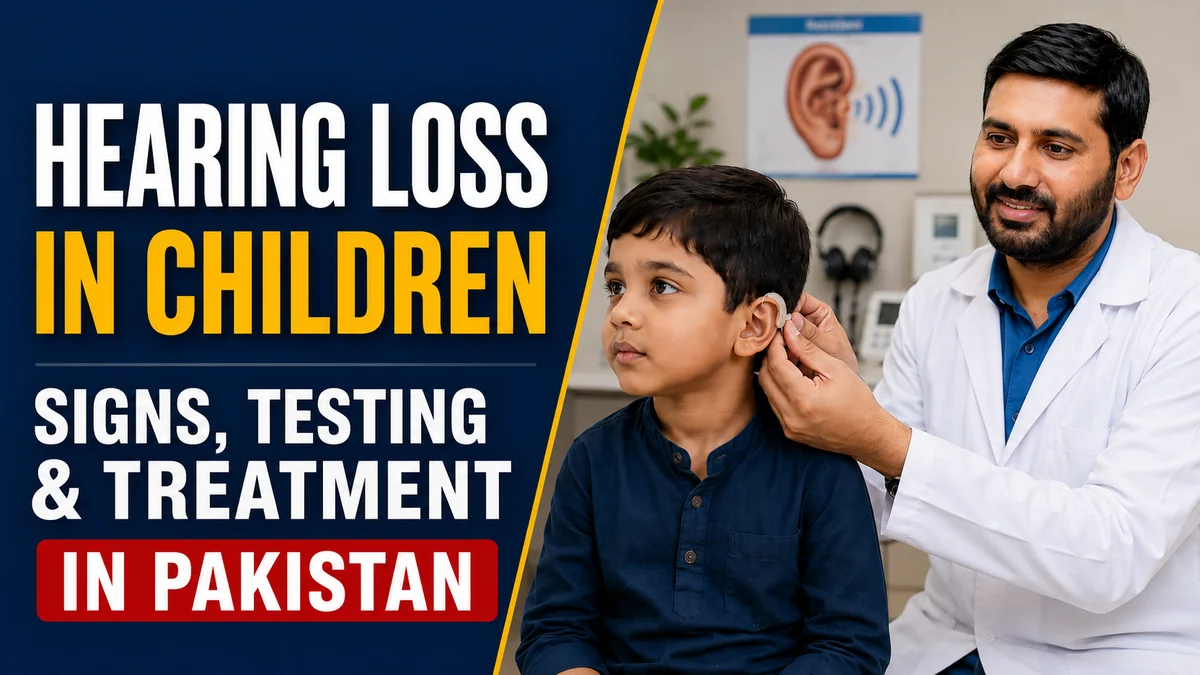
For children with permanent hearing loss, hearing aids are often the first intervention. Modern hearing aids are small, powerful and available in child-friendly designs. They amplify sound so that the child can hear more clearly and continue to develop language and speech naturally.
Fitting a hearing aid for a child requires specialist audiological assessment and regular follow-up to ensure the device is adjusted as the child grows.
Cochlear Implants
For children with severe to profound sensorineural hearing loss who do not benefit sufficiently from hearing aids, a cochlear implant may be recommended. This is a surgically implanted device that directly stimulates the auditory nerve, bypassing the damaged parts of the inner ear.
Cochlear implantation is available in Pakistan at selected centres and is most effective when performed in young children before the age of three, when the brain is still highly adaptable for language learning.
Speech and Language Therapy
Hearing loss and speech development are deeply connected. A child who cannot hear clearly will not develop language at the expected pace without intervention. Speech and language therapy is a critical component of treatment for most children with hearing loss — helping them develop communication skills regardless of whether they use hearing aids, cochlear implants or sign language.
Auditory Verbal Therapy (AVT)
This is a specialised form of therapy that focuses on teaching children with hearing loss to listen and speak using their residual hearing, amplified through hearing aids or cochlear implants. It is highly effective when started early.
Hearing Loss and Speech Development — The Connection
Many parents do not realise how closely hearing and speech are linked. A child learns to speak by hearing language around them — by listening to words, sentences and the rhythm of conversation. When hearing is impaired, that input is reduced or distorted, and speech development suffers as a result.
Children with untreated hearing loss often show:
- Delayed first words and sentences
- Unclear or difficult-to-understand speech
- Limited vocabulary
- Difficulty with reading and academic performance
This is why early diagnosis and treatment are so important. The earlier a child receives appropriate hearing support, the less impact the hearing loss will have on their language development.
Hearing Loss Testing and Treatment in Pakistan
Access to audiological services in Pakistan has improved in recent years, particularly in larger cities. Families in Islamabad and Rawalpindi can now access professional hearing assessments, hearing aid fitting and auditory rehabilitation through certified clinics.
Our audiology and hearing services at Speech Rehab Clinic cover comprehensive hearing assessments for children and adults, hearing aid evaluation and fitting, and specialist referrals for cochlear implant assessment. Our team works closely with speech therapists to provide integrated care — because treating hearing loss and supporting speech development together produces far better outcomes than addressing each in isolation.
Frequently Asked Questions
Can hearing loss in children be cured?
It depends on the type. Conductive hearing loss caused by infections or fluid is often treatable and may resolve completely. Sensorineural hearing loss is usually permanent but can be very effectively managed with hearing aids or cochlear implants combined with therapy.
At what age should a child’s hearing be tested?
Ideally, all newborns should be screened at birth. If screening was not done or if you have concerns at any age, a hearing test can be carried out from birth onwards using appropriate testing methods.
Is hearing loss common in Pakistan?
Yes. Hearing loss is one of the most common sensory impairments in children globally, and Pakistan is no exception. Factors including high rates of consanguineous marriage, limited newborn screening and untreated ear infections contribute to a significant burden of childhood hearing loss in the country.
Can a child with hearing loss go to a normal school?
Many children with hearing loss attend mainstream schools with appropriate support — including hearing aids, classroom accommodations and speech therapy. The right level of support depends on the severity of the hearing loss and the child’s individual needs.
What is the difference between a hearing test and an audiological assessment?
A hearing test measures whether a child can hear sounds at specific volumes and frequencies. An audiological assessment is more comprehensive — it includes hearing testing along with evaluation of middle ear function, speech understanding and recommendations for intervention.
How do I know if my child needs a hearing aid?
This is determined by an audiologist following a full hearing assessment. Hearing aids are typically recommended when a child has a hearing loss of 25 decibels or more in the frequencies important for speech.
Is sign language better than oral communication for deaf children?
There is no single right answer. The decision depends on the child’s degree of hearing loss, family preferences and the recommendations of the clinical team. Many children with cochlear implants or hearing aids develop strong oral communication skills. Others benefit from sign language. A good specialist team will help families make an informed choice.
Conclusion
Hearing loss in children is a serious but highly manageable condition when it is identified early and treated appropriately. The most important thing any parent can do is act on their instincts. If something feels wrong with your child’s hearing or speech development, do not wait for the next check-up or hope it resolves on its own.
Early diagnosis opens the door to early intervention. And early intervention — whether through hearing aids, surgery, therapy or a combination — gives children with hearing loss the best possible chance of developing language, learning and connecting with the world around them.
If you have concerns about your child’s hearing, book a professional assessment today. The right support at the right time makes all the difference.