
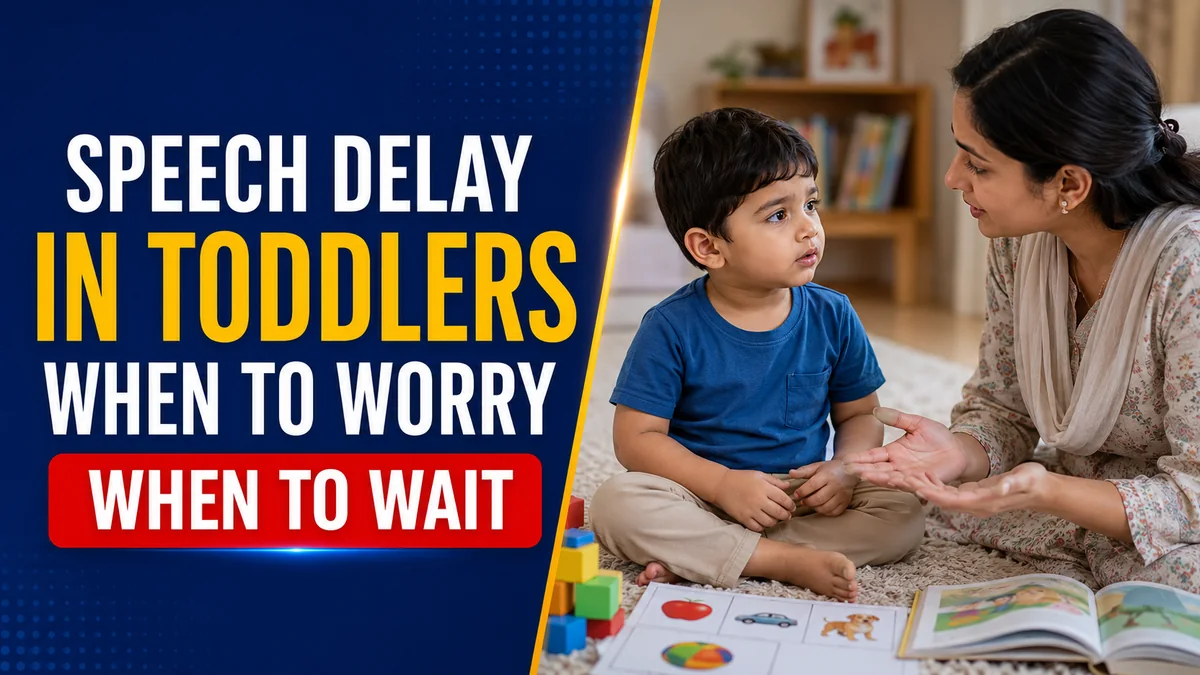

Introduction
As a parent, few things are more unsettling than wondering whether your child is developing the way they should. Speech is often the first area where concerns surface — a toddler who is quieter than their peers, who is not yet using words, or whose words are difficult to understand. The question almost every parent asks at some point is: is this something I should be worried about, or will they simply catch up on their own? Understanding what is typical, what is not, and when to seek professional help is one of the most important things a parent can do for their child’s development.
This article explains speech delay in toddlers clearly and honestly — what causes it, what the warning signs are, when it is appropriate to wait and when early action is the better choice. For a broader understanding of what speech therapy involves and how it helps, read our complete guide on what is speech therapy.
What Is Speech Delay?
Speech delay means that a child’s speech and language development is behind what is expected for their age. It is one of the most common developmental concerns in young children and affects a significant number of toddlers worldwide.
It is important to understand that speech delay is not a single, uniform condition. It exists on a spectrum — from mild delays that resolve on their own with time and encouragement, to more significant delays that require specialist support to address. The type and cause of the delay determines how it should be managed.
Speech delay is also different from language delay, though the two are often discussed together:
- Speech delay — difficulty producing sounds and words clearly. The child may know what they want to say but struggle to say it.
- Language delay — difficulty understanding or using language. The child may have limited vocabulary, struggle to follow instructions or have difficulty putting words together.
Many children experience both simultaneously, which is why a comprehensive assessment by a qualified speech and language therapist is always more informative than a parent’s observation alone.
What Causes Speech Delay in Toddlers?
Speech delay can arise from a wide range of causes, and in some cases no single cause can be identified. The most common contributing factors include:
- Hearing loss — one of the most common and most overlooked causes of speech delay. A child who cannot hear speech clearly cannot learn to produce it accurately. Hearing should always be assessed when speech delay is identified.
- Premature birth — children born prematurely are at higher risk of developmental delays including speech and language difficulties.
- Autism spectrum disorder — delayed or atypical speech and communication development is one of the early signs of autism in many children.
- Intellectual disability — children with cognitive delays often have associated speech and language difficulties.
- Oral motor difficulties — some children have difficulty coordinating the muscles of the mouth, lips and tongue needed for clear speech production.
- Limited language exposure — children who have less exposure to conversation, reading and verbal interaction at home may develop language more slowly.
- Bilingual environment — children learning two languages simultaneously may appear delayed in each language individually while their total language knowledge across both languages is developing typically.
- Genetic or family history — speech and language difficulties sometimes run in families, suggesting a genetic component in some cases.
Identifying the underlying cause is an important part of the assessment process, as it guides the most appropriate treatment approach.
Warning Signs of Speech Delay — By Age
Every child develops at their own pace, and there is a range of what is considered typical at each age. However, there are clear milestones that most children reach by specific ages, and missing several of these milestones is a meaningful signal that professional assessment is warranted.
By 12 Months
- Not yet babbling or making varied consonant sounds
- Does not respond to their own name
- Does not gesture — no pointing, waving or reaching
- Not yet saying any recognisable words
By 18 Months
- Fewer than 10 words in their vocabulary
- Does not point to show things of interest
- Does not follow simple one-step instructions such as “come here” or “give me”
- Speech is not understood by familiar adults
By 2 Years
- Fewer than 50 words
- Not yet combining two words together such as “more milk” or “daddy go”
- Does not use words to communicate needs and wants
- Loss of words or skills they previously had
By 3 Years
- Strangers cannot understand most of what the child says
- Not yet using short sentences
- Cannot follow two-step instructions
- Does not ask questions
If your child is missing several milestones at their age level, professional assessment is the recommended next step. For a detailed breakdown of what children should be doing at each stage, read our guide on speech and language milestones in children.
When Is It Okay to Wait?
Not every child who appears delayed will have a lasting difficulty. Some children are simply late talkers — children who develop speech and language later than average but who catch up on their own without any intervention.
Late talkers are typically children who:
- Show good understanding of language even if they are not yet speaking much
- Communicate clearly through gestures, facial expressions and eye contact
- Are developing well in all other areas
- Show interest in communicating and interacting with others
- Have no identified hearing difficulty
For these children, a period of watchful waiting with active support at home — more talking, more reading, more interaction — may be appropriate for a short time. However, even for late talkers, professional assessment is almost always worthwhile. An assessment does not commit you to therapy. It gives you accurate information about where your child stands and what, if anything, needs to be done.
Waiting without professional guidance is a different matter. If a parent is concerned, the waiting period can be deeply anxious. And if the child does need support, every month of delay in starting therapy is a month of a critical developmental window that cannot be recovered.
When Should You Act Without Waiting?
There are specific situations where waiting is not the right approach and professional assessment should be sought promptly:
- Any loss of skills — if a child loses words or communication abilities they previously had, this is always a reason to seek assessment without delay.
- No words by 16 months — a child who has no recognisable words by 16 months should be assessed rather than observed.
- Not combining words by 24 months — a child not yet putting two words together by their second birthday warrants professional evaluation.
- Hearing concerns — if you have any reason to suspect your child is not hearing normally, audiology assessment should happen immediately alongside speech assessment.
- Autism-related concerns — if your child shows limited eye contact, limited interest in other people, repetitive behaviours or atypical social communication alongside speech delay, early evaluation is urgent.
- Significant frustration or distress — if your child is becoming frustrated, withdrawn or distressed because they cannot communicate effectively, this is a sign that the delay is affecting their quality of life and warrants action.
What Happens in a Speech Delay Assessment?
A speech delay assessment is carried out by a qualified speech and language therapist. It is not a test your child can pass or fail. It is a professional evaluation of where your child currently is and what, if anything, would help them.
A typical assessment includes:
- A detailed discussion with parents about the child’s developmental history, family history and current concerns
- Observation of how the child communicates during play and interaction
- Structured activities to assess vocabulary, understanding, sentence building and sound production
- Screening questions about hearing, behaviour and social communication
At the end of the assessment, the therapist will explain their findings clearly, confirm whether a delay is present, describe its nature and severity, and recommend the most appropriate next steps — whether that is therapy, further assessment by another specialist, or active monitoring with home support strategies.
What Can Parents Do at Home?
While waiting for an assessment or alongside therapy, there is a great deal parents can do to support their child’s speech and language development at home. The most important thing is that these strategies work through natural interaction rather than formal exercises.
- Talk constantly — narrate your day. Describe what you are doing, what you see, what is happening. The more language a child hears in context, the more they learn.
- Read together every day — books expose children to vocabulary, sentence structures and ideas they would not encounter in everyday conversation. Even pointing at pictures and naming them is valuable.
- Get down to their level — face-to-face interaction is more stimulating for language development than talking from above or across the room.
- Follow their lead — comment on what your child is interested in and doing rather than directing or correcting. This keeps them engaged and motivated to communicate.
- Expand what they say — if your child says “ball”, you say “yes, big red ball.” This models slightly more complex language without pressure.
- Reduce screen time — passive screen time does not support language development the way real human interaction does. Prioritise face-to-face time.
- Do not pressure or correct — pressuring a child to say words or correcting their pronunciation creates anxiety around communication. Keep interactions warm, positive and pressure-free.
Frequently Asked Questions
My child understands everything but will not talk. Is that still a speech delay?
Yes, this can still be a speech delay — specifically an expressive language delay. A child who understands language well but is not yet producing it at the expected level benefits from professional assessment. Good comprehension is a positive sign and often associated with a better outcome, but it does not mean the delay does not need attention.
Could my child just be a late talker who will catch up on their own?
Some children are late talkers and do catch up. However, the research shows that a significant proportion of late talkers — especially those without strong comprehension — do not fully catch up without support. A professional assessment is the only reliable way to distinguish a true late talker from a child who needs therapy. Waiting without assessment is a risk that is rarely worth taking.
My child is bilingual. Could that be causing the delay?
Bilingualism does not cause speech delay. Bilingual children may appear to have smaller vocabularies in each individual language, but their total vocabulary across both languages is typically within normal range. If a bilingual child is delayed in both languages and shows limited communication overall, assessment is warranted regardless of the bilingual environment.
At what age is it too late to start speech therapy for a toddler?
It is never too late to start speech therapy, but earlier is consistently better. The earlier a child begins therapy, the greater the benefit of the brain’s natural plasticity during the critical period of language development. If you have concerns, seek assessment now rather than waiting for a more convenient time.
What should I do if my child’s nursery or paediatrician has flagged a speech concern?
Act on it promptly. A referral from a nursery or paediatrician reflects a professional observation that something warrants assessment. Do not wait to see if the concern resolves on its own. Book an assessment with a qualified speech and language therapist as soon as possible. If you are based in Islamabad or Rawalpindi, our speech therapy clinic in Islamabad offers comprehensive assessments for toddlers and children with speech and language concerns, carried out by certified speech and language pathologists.
Conclusion
Speech delay in toddlers is common, often treatable, and almost always best addressed early. The hardest part for most parents is knowing when to act and when a period of watchful waiting is appropriate. The honest answer is that professional assessment — even when the outcome is reassurance that everything is on track — is almost always the right step when a concern exists.
A concern that turns out to be nothing costs you an appointment. A concern that is left unaddressed costs your child months or years of a critical developmental window.
If you have concerns about your toddler’s speech or language development, do not wait. Book a professional assessment today. Our certified speech and language pathologists provide comprehensive evaluations for children across Islamabad and Rawalpindi, with clinic, home visit and online options available.