
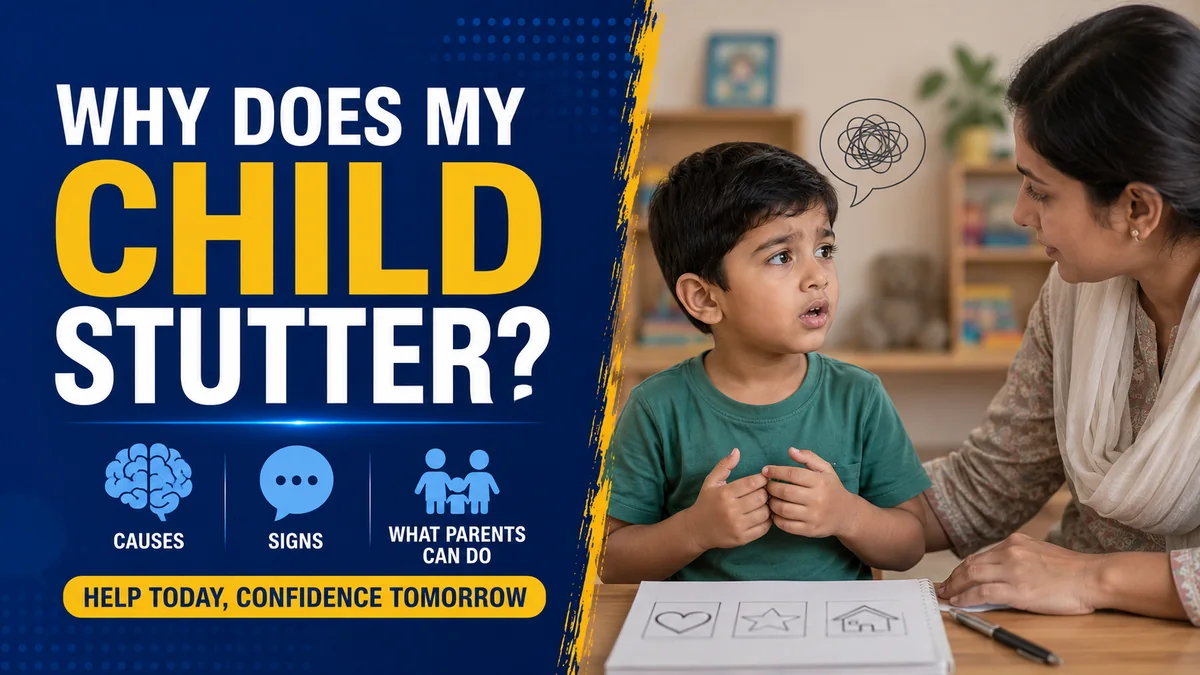

Your four-year-old is in the middle of telling you something exciting. You can see it on their face — they are bursting to share it. But the words are not coming out the way they want. They get stuck on a sound, repeat it several times, and then stop altogether. You wait. You smile. Inside, you are trying very hard not to show the worry that has just landed in your chest.
If this sounds familiar, you are not alone. Stuttering is one of the most common fluency concerns parents bring to speech therapists — and one of the most misunderstood. There is a great deal of confusion about what causes it, whether it is serious, and what parents should do. This article is here to give you clear, honest answers to all of those questions.
Firstly What Is Stuttering, Exactly?
Stuttering is a disruption in the flow of speech. Most people think of it as repeating sounds — “c-c-c-can I have water” — and that is certainly one form. But stuttering also includes prolonging sounds (“sssssorry”), getting completely stuck on a word with no sound coming out at all, and the physical tension that sometimes accompanies these moments — a child squeezing their eyes shut, tapping their foot, or turning their head to force the word out.
What stuttering is not is shyness, nervousness, low intelligence, or a sign that something is wrong with a child’s thinking. Children who stutter know exactly what they want to say. The difficulty is in the production of the words, not in the ideas behind them. This distinction matters enormously — for how parents respond, for how teachers treat the child, and for how the child eventually comes to understand their own speech.
“Stuttering is not about what a child thinks. It is about how speech is produced. The two things are completely separate.”
How Common Is Stuttering in Children?
More common than most parents realise. Around 5 percent of all children stutter at some point during childhood — which means roughly one in twenty children. It is significantly more common in boys than in girls, with boys being about three to four times more likely to stutter.
The good news is that the majority of children who stutter — around 75 to 80 percent — recover naturally without any intervention, usually by the time they reach school age. This is one of the reasons stuttering can be confusing to navigate as a parent. The possibility of natural recovery is real. But it is not guaranteed. And the children who do not recover naturally benefit enormously from early professional support.
The challenge is knowing which category your child falls into — and that is not something a parent can determine from observation alone.
What Causes Stuttering?
This is the question parents ask most urgently — and the honest answer is that there is no single cause. Stuttering is a complex condition with multiple contributing factors, and researchers are still working to fully understand it. What we do know is this:
It Is Largely Genetic
Stuttering runs in families. Around 60 percent of people who stutter have a family member who also stutters or stuttered at some point. This does not mean it is inevitable if there is a family history, but it does mean genetics play a significant role. If your child stutters and you or your spouse or a sibling also stuttered, that context is worth sharing with the speech therapist during the assessment.
It Is Related to How the Brain Processes Speech
Research using brain imaging has found differences in the way the brains of people who stutter process and coordinate the complex sequence of muscle movements required for fluent speech. Speech is one of the most physically demanding things the human body does — it requires the precise coordination of dozens of muscles in the lips, tongue, jaw, throat and breathing system, all working in a sequence that happens faster than conscious thought. In people who stutter, this coordination is disrupted in specific ways.
It Is Not Caused by Parenting
This is perhaps the most important thing to say clearly: stuttering is not caused by anything parents did or did not do. It is not caused by speaking too fast around the child, by emotional stress in the home, by a frightening experience, or by any parenting approach. Decades of research have consistently found that parenting behaviour does not cause stuttering.
Pakistani parents in particular sometimes carry guilt about this — wondering whether they spoke in multiple languages, whether there was too much noise in the house, whether they were too busy or too demanding. None of these things cause stuttering. Let that go.
Why Does It Seem to Come and Go?
One of the most confusing things about stuttering for parents is that it is inconsistent. A child might speak fluently for days or even weeks, and then stutter heavily for a period. It can be worse when the child is tired, excited, anxious or speaking on the phone. It can be completely absent in certain situations — singing, whispering, speaking to a pet, or talking to themselves while playing.
This variability is a feature of stuttering, not an accident. It does not mean the child is choosing to stutter or could stop if they tried hard enough. It reflects the fact that fluency is affected by the demands placed on the speech system — emotional, cognitive and linguistic. Understanding this helps parents respond more effectively.
Normal Dysfluency vs Stuttering, How to Tell the Difference
Here is something that surprises many parents: most children go through a period of dysfluency — hesitations, repetitions and stumbles in their speech — that is completely typical and not stuttering at all. This usually happens between the ages of 2 and 5, when language is developing rapidly and the child’s ideas outpace their ability to produce words fluently.
Typical developmental dysfluency looks like whole-word repetitions (“I want I want I want a biscuit”), hesitations and fillers (“um… I… I went to the park”), and occasional phrase repetitions. It tends to come and go, does not seem to bother the child, and is not accompanied by physical tension or struggle.
The signs that suggest something beyond typical dysfluency include: sound or syllable repetitions rather than whole words (“b-b-b-biscuit”), prolonging sounds, getting completely stuck with no sound coming out, physical tension or struggle visible in the face or body, the child showing awareness or frustration about their speech, and stuttering that has been present for six months or more without improving. If several of these are present, a professional assessment is strongly recommended.
“If your child is showing awareness of their stutter — covering their mouth, avoiding speaking, saying ‘I can’t say it’ — that is a signal to seek help sooner rather than later.”
The Signs to Watch For
As a parent, the most useful thing you can do is observe — not with anxiety, but with attention. Here are the specific things that speech therapists look for when assessing whether a child’s dysfluency warrants support:
Sound and syllable repetitions are the clearest sign. Not repeating a whole word, but getting stuck on the first sound or syllable and repeating it multiple times before getting through. The more times the sound is repeated and the faster the repetitions, the more concerning the pattern.
Physical struggle and tension are significant warning signs. A child who is working hard to get words out — blinking, tensing their jaw, looking away, tapping — is showing that the stuttering is creating physical and emotional strain. This is worth addressing early.
Avoidance behaviours develop when stuttering goes unaddressed. A child who stops talking as much as they used to, avoids certain words or situations, says “I don’t know” when they do know, or stops putting their hand up in class may be managing their stutter by avoiding speech. Avoidance is one of the most damaging long-term effects of untreated stuttering.
The child’s emotional response to their speech matters as much as the speech itself. A child who is frustrated, embarrassed, distressed, or increasingly reluctant to speak needs support — regardless of how mild or severe the stutter looks to an outside observer.
What Makes Stuttering Better or Worse?
Understanding the conditions that affect fluency helps parents create an environment that supports their child’s speech without adding pressure.
Stuttering is typically worse when a child is tired, ill, excited, or anxious. It is worse when they feel rushed, when they are speaking to an unfamiliar person or in an unfamiliar setting, when they are put on the spot, or when they sense that someone is reacting negatively to their speech. It is also worse during periods of rapid language development — when a child is learning a lot of new words and sentence structures at once.
Stuttering is typically better when a child is relaxed, in a familiar environment, and feels no pressure around their speech. It is often completely absent when a child sings, whispers, speaks in unison with someone else, or talks to animals. These moments of fluency are not evidence that the child is “putting it on” or could speak fluently all the time if they wanted to. They are evidence of how sensitive speech production is to the conditions around it.
What Pakistani Parents Specifically Need to Know
Do Not Tell Your Child to Slow Down or Start Again
This is the most common piece of advice Pakistani parents receive from family members — and it is the most harmful. Telling a child to slow down, take a breath, think before they speak, or start again communicates that there is something wrong with the way they are speaking. It draws attention to the stutter. It creates anxiety. And it almost always makes the stuttering worse, not better.
The child already knows they are struggling. What they need is not instruction to speak differently. They need to feel safe enough to speak at all.
Do Not Finish Their Sentences
When a child is stuck, the instinct to jump in and help is natural and loving. But finishing a child’s sentence or supplying the word they are stuck on consistently teaches the child that their speech is a problem that needs to be solved by someone else. It reduces their confidence and their willingness to attempt difficult words. Wait. Give them the time they need. The patience you show them becomes the patience they develop toward themselves.
Maintain Eye Contact and Normal Facial Expression
When a child stutters, parents sometimes look away, look worried, or show visible discomfort. The child notices all of it. Maintain relaxed eye contact. Keep your expression warm and interested in what they are saying — not in how they are saying it. The message you want to send is: I am listening to you, and what you have to say matters to me.
Reduce Communication Pressure at Home
Some Pakistani family environments are very high-energy and communicatively demanding — lots of questions, lots of people talking at once, lots of pressure to perform in front of guests or extended family. None of this causes stuttering. But it can make existing stuttering more difficult to manage. Creating some low-pressure speaking opportunities at home — one-to-one conversations, unhurried bedtime chats, reading together — gives a stuttering child space to practise speaking without an audience.
Protect Your Child From Teasing
In Pakistani schools and family gatherings, children who stutter are sometimes mimicked, teased, or laughed at — sometimes by adults who think it is harmless. It is not harmless. Teasing about speech has a documented negative effect on confidence, willingness to speak, and long-term outcomes for children who stutter. If your child is being teased at school, it needs to be addressed directly with the school. If it is happening within the family, address it clearly and without apology.
When Should You Seek Professional Help?
The answer to this question is almost always: sooner than you think. Here are the specific situations where waiting is not the right approach:
Seek assessment if the stuttering has been present for six months or more without clear improvement. Natural recovery tends to happen within the first year or two. Stuttering that persists beyond six months is less likely to resolve on its own.
Seek assessment if your child is four years or older and still stuttering. The older a child is when stuttering persists, the less likely it is to resolve without support.
Seek assessment if your child has a family history of stuttering that persisted into adulthood. This is a risk factor for persistent stuttering rather than natural recovery.
Seek assessment if your child is showing emotional distress, avoidance, or a reduction in their willingness to speak. These signs indicate that the stutter is already affecting the child’s life in ways that need attention.
Seek assessment if you are worried. You do not need a checklist to justify an assessment. A parent’s concern is reason enough.
“Early assessment does not mean early labelling. It means early information — and information is always better than uncertainty.”
What Does Treatment Look Like?
This is where many parents feel most uncertain — they are not sure what speech therapy for stuttering actually involves or whether it will work. For a detailed picture of what a therapy session looks like in practice, we will cover that in a dedicated guide. For now, the important thing to understand is that effective treatment exists, it works, and the earlier it starts the better. If you would like to understand the broader context of what speech therapy covers and how it helps, our complete guide to speech therapy in Pakistan is a good starting point.
Treatment approaches vary depending on the child’s age. For younger children, therapy often works indirectly through parent guidance — teaching parents how to modify their own communication style in ways that create the conditions for fluency. For older children and adults, therapy is more direct, teaching specific techniques for managing stuttering and building confidence around speech.
What does not work is telling a child to try harder, slowing them down artificially, or waiting for them to grow out of it past the age where natural recovery is likely. What does work is evidence-based therapy delivered by a qualified speech and language therapist who has specific experience with fluency disorders.
A Word for Parents Who Stutter Themselves
If you are a parent reading this because you stutter yourself, you may be carrying a particular kind of weight. You know what it feels like. You know the moments of frustration, the situations you avoid, the words you substitute. And you are probably watching your child with a mixture of empathy and dread.
The most important thing to know is that the outcome for your child does not have to mirror your own experience. Treatment has improved enormously. Awareness has improved. And catching it early — which you are already doing by reading this — gives your child a significantly better chance of developing a healthy relationship with their speech, whatever form that takes.
The Bottom Line
Stuttering is common, it is not your fault, it is not the child’s fault, and it is not something to be ignored or managed with well-meaning advice to slow down. It is a speech and language condition that responds well to professional support — particularly when that support starts early.
The most useful thing you can do right now is pay attention to what you are observing, create a low-pressure speaking environment at home, and seek a professional assessment if you have any concerns. You do not need to be certain there is a problem to justify asking for help. Curiosity is enough. Concern is enough. And getting an assessment that tells you everything is fine is never a waste of time.
If you are based in Islamabad or Rawalpindi and would like a professional assessment for your child’s speech fluency, our speech therapists in Islamabad and Rawalpindi include specialists in childhood fluency disorders who work with children and families in a warm, supportive environment. Early support makes a real difference. Reach out today.