
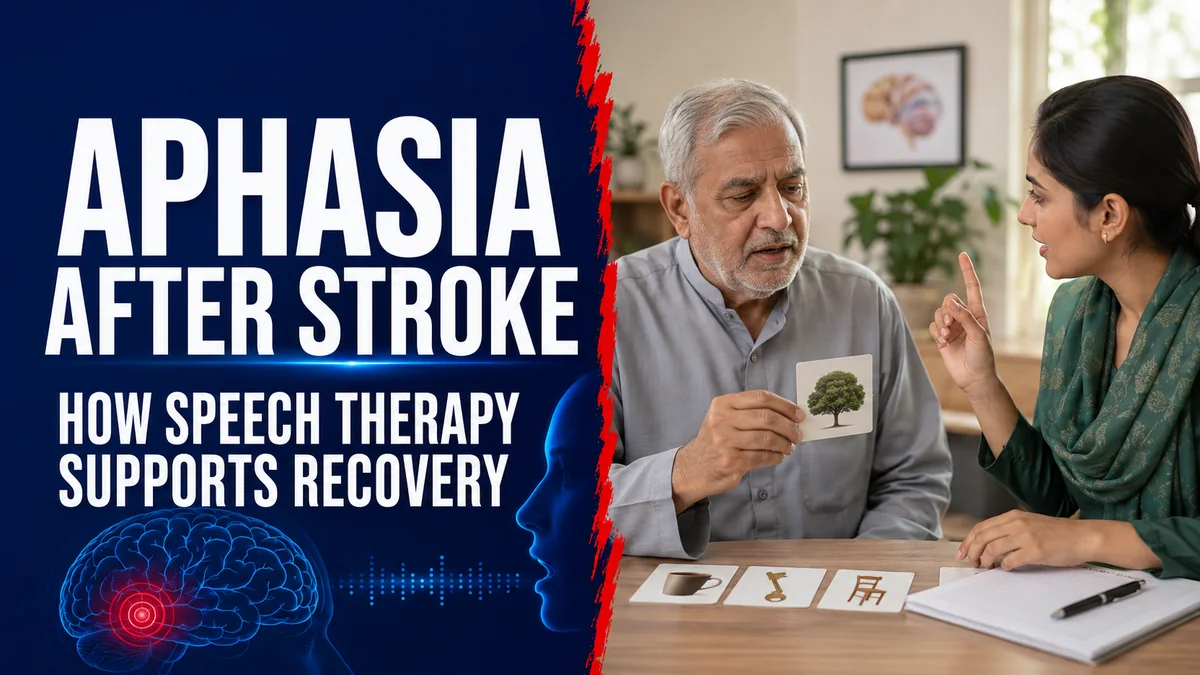

Your parent or spouse has had a stroke. The medical team has stabilised them, and now you are sitting at the bedside watching someone who was speaking normally a few days ago struggle to find words: or produce none at all.
You are told this is aphasia. You are told speech therapy will help. And then you are largely left to figure out what that actually means.
This article is written for that moment: for the family member who needs to understand what aphasia is, why timing matters, what therapy actually involves, and how to access specialist support in Pakistan.
In our clinic, this is one of the most common situations we see: a family arriving weeks or months after the stroke with no idea that specialist support was available. Our guide on speech therapy for children and adults in Pakistan provides broader context if you are new to the field.
What Aphasia Actually Is: And What It Is Not
Aphasia is an acquired language impairment. It occurs when a stroke damages the areas of the brain responsible for processing and producing language: most commonly in the left hemisphere.
It affects the ability to speak, understand spoken language, read, or write. Sometimes partially. Sometimes severely. Every case is different.
What aphasia is not:
- A sign of reduced intelligence
- Dementia
- A reflection of how hard the person is trying
A person with aphasia may know exactly what they want to say and be completely unable to say it. They may understand everything being said and be unable to respond. They may produce the wrong words: or sounds that are not words at all.
One of the first things we tell families in our clinic is this: the person in front of you is the same person. Their language is disrupted. Their mind is not.
Treating someone with aphasia as though they have become less intelligent: speaking loudly, finishing their sentences, or leaving them out of conversations: is something well-meaning families do without realising it. It consistently increases the person’s distress and slows recovery.
The Different Types of Aphasia
Understanding the type of aphasia your family member has helps you understand what therapy will focus on and what progress may look like.
Broca’s Aphasia (Expressive / Non-Fluent)
Affects speech production. The person understands what is said to them reasonably well but produces speech with great effort: short, halting phrases rather than fluent sentences.
They know what they want to say but cannot produce it smoothly. This is often accompanied by significant frustration.
Wernicke’s Aphasia (Receptive / Fluent)
Affects language comprehension. The person may speak fluently and at length but produce sentences with wrong words, made-up words, or combinations that do not make sense.
They may not fully recognise that what they are saying is unclear: which can make communication particularly difficult for families to navigate.
Global Aphasia
The most severe form, affecting both production and comprehension significantly. It typically results from more extensive left hemisphere damage.
We have worked with patients presenting with global aphasia who, with the right support started early enough, have made far more progress than their families initially believed possible.
Many people present with mixed features rather than a pure type. A thorough assessment by a qualified speech and language pathologist determines exactly what pattern of difficulty exists and what approach will help most.
Why Timing Matters More Than Most Pakistani Families Realise
In Pakistan, families dealing with a stroke in the acute phase focus on survival and medical stabilisation. Speech therapy feels like something that comes later: once the patient is home and more settled.
This is understandable. But in over ten years of working with aphasia patients and their families, it is the single most consequential missed opportunity we see.
Why early therapy matters:
- The brain’s neuroplasticity: its capacity for recovery: is highest in the weeks immediately following a stroke
- During this period, the brain actively recruits alternative pathways to compensate for damaged functions
- Speech therapy that begins early supports and accelerates this process
- Therapy that begins months later works with a brain that has already begun to settle into its compensatory patterns: making change harder
Meaningful recovery is still possible at any stage. But the potential for the fastest and most complete recovery is greatest in the early weeks.
The question to ask in the hospital, as soon as the patient is medically stable: can a speech and language pathologist assess my family member now? Not next month. Not after discharge. Now.
What Speech Therapy for Aphasia Actually Involves
Families often have no idea what sessions look like, which makes it harder to commit to them and harder to support the person going through them.
Here is what the process actually involves:
- Comprehensive assessment: the therapist evaluates the specific pattern of aphasia, what language abilities remain, and how the person communicates through non-verbal means as well as speech. This is not a test to pass or fail. It is a diagnostic map.
- Individualised therapy sessions: structured work on the specific language functions that were disrupted. Word retrieval, sentence construction, reading, writing, or functional communication strategies depending on what each person needs.
- Home practice: effective aphasia therapy does not happen only in the clinic. Exercises and strategies established in sessions need to be practised consistently at home between appointments.
- Family involvement: in our experience, the families who are most actively involved in between-session practice consistently see faster and more durable progress.
Progress in aphasia recovery is rarely linear. Plateaux are normal: they are not signs that therapy has stopped working. They are often followed by further improvement when the right approach is applied at the right time.
What Families in Pakistan Need to Know About Accessing Support
Aphasia is significantly underserved in Pakistan’s healthcare system. Most families receive neurology and physiotherapy support relatively easily: but are not routinely referred to speech and language therapy even when communication difficulties are clearly present.
The consequence is that many stroke survivors in Pakistan go months or years with unaddressed aphasia. We see this pattern regularly: families who arrive saying they had no idea where to go or whether anything could be done.
For families in Islamabad and Rawalpindi, our speech therapy clinic in Islamabad provides specialist assessment and therapy for adults with aphasia following stroke. We work with both the person with aphasia and their family as active participants in the recovery process, and offer online sessions for families who cannot attend in person.
How to Support a Family Member With Aphasia at Home
The hours between therapy sessions are where a significant part of recovery happens. These are the adjustments we discuss with every family we work with:
- Reduce background noise: turn off the television when communicating. Conversations are significantly harder with distractions
- Give the person time: do not rush to fill silences or finish sentences. Those extra seconds are the brain working
- One question at a time: short, simple sentences reduce the processing load at a moment when language requires significant effort
- Accept all communication: pointing, writing, drawing, gesturing. The goal is connection, not correct speech
- Do not correct every error: your therapist will guide you on which errors to address and how
- Keep them involved: in family conversations, decisions, daily life. Aphasia does not change who the person is
These adjustments are not complicated. But they make an enormous difference: both to recovery and to the quality of connection within the family during a very difficult time.
What Recovery Looks Like Over Time
Recovery from aphasia is genuinely variable. Some people recover most of their language function within weeks, particularly if aphasia was mild and therapy began early. Others make steady progress over months and years.
Some people are left with chronic aphasia that does not fully resolve: but learn to communicate effectively through a combination of recovered speech, compensatory strategies and supportive communication environments.
What the research consistently shows: and what our own clinical experience confirms: is that the people who do best receive early, consistent therapy with actively involved families. The therapist cannot do this alone. The family cannot do it alone. The most effective recovery happens when both work together.
If you are at the beginning of this journey: early action matters, and specialist support is available. The sooner a proper assessment begins, the more of the recovery window remains open.
About the Author
Imran Malik is the CEO of Speech Rehab Clinic and a Speech and Language Pathologist with over 10 years of clinical experience. He holds an M.Phil in Speech and Language Therapy and specialises in aphasia rehabilitation, cognitive communication disorders, autism, stuttering and voice disorders.