
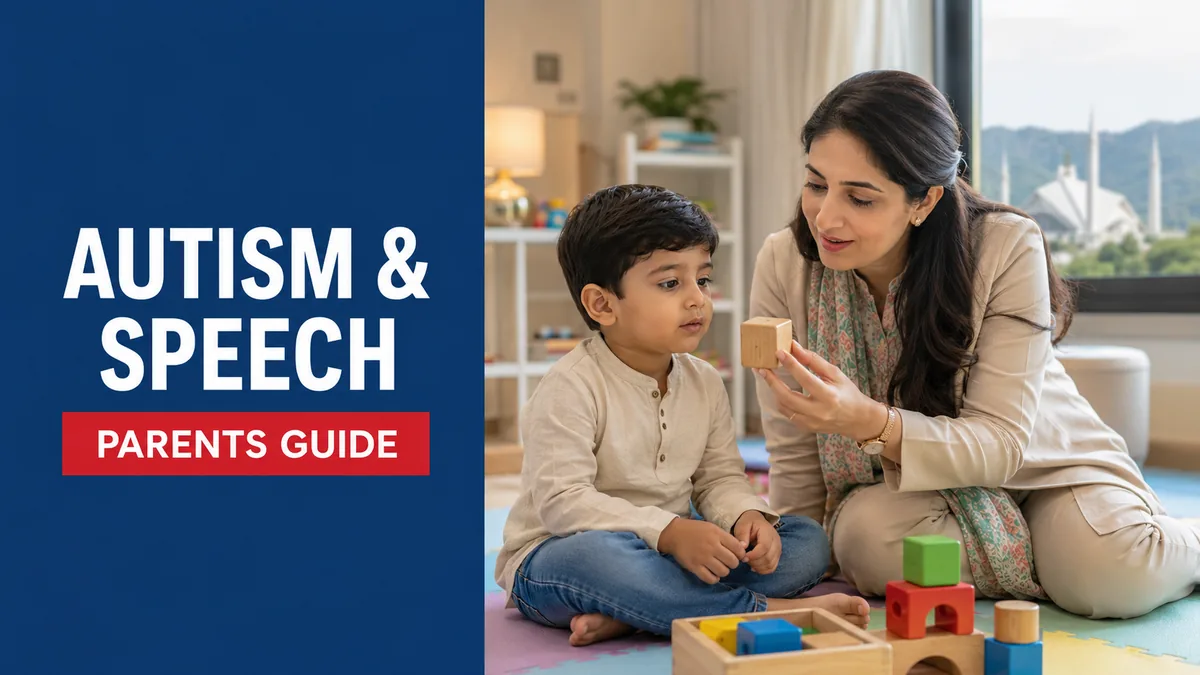

One of the most common questions parents ask when their child is not speaking on the expected timeline is whether the delay means their child is autistic. It is a fair question, and an understandable one — autism is one of the conditions most frequently associated with speech delay in the public conversation, and the connection between the two is real. But the relationship is more nuanced than “speech delay equals autism,” and understanding that nuance is important for any Pakistani parent trying to make sense of what they are observing in their child.
This article explains how autism and speech delay are connected, what makes communication difficulties in autism different from other types of speech delay, what parents should look for, and what kind of support actually helps. If you are still building a general understanding of speech therapy and how it works, our broader guide on speech therapy for children in Pakistan is a useful starting point alongside this article.
Speech Delay Is Common. Autism Is One of Several Possible Reasons.
It is important to start with this point because it is the single most reassuring and most clinically accurate thing to understand: speech delay has many possible causes, and autism is only one of them.
Children can have delayed speech because of hearing difficulties, because of a primary language disorder unrelated to autism, because of limited language exposure or stimulation, because of a general developmental delay affecting multiple areas, or, in many cases, with no identifiable cause at all — simply a child who develops language on their own slightly later timeline and catches up with appropriate support.
Autism spectrum disorder is one specific condition that frequently includes speech and language delay as one of its features, but it is far from the only explanation. A child who is not speaking by 18 months to 2 years should be assessed, but the assessment exists precisely to determine which of these possibilities applies — not to confirm a single assumed diagnosis.
What Makes Communication Differences in Autism Distinctive
When speech delay is connected to autism, it is rarely an isolated finding. What distinguishes autism-related communication difficulties from other types of speech delay is the pattern of how the difficulty presents alongside other developmental features.
In autism, the communication difficulty is often broader than just spoken words. A child may have delayed speech, but alongside that delay there are often differences in how the child uses gestures, how they make eye contact, how they respond to their name being called, how they engage in back-and-forth social interaction, and how they use play. A child with a primary speech delay unrelated to autism typically shows strong social engagement, eye contact, gesture use and interest in interaction — they simply are not yet producing words at the expected rate.
Another distinctive feature in autism is the pattern of language itself when it does emerge. Some autistic children develop language that includes echolalia, repeating words or phrases they have heard without using them in the typical communicative way at first. Others may develop a vocabulary of words related to their specific interests while showing less interest in the everyday social vocabulary that most toddlers acquire first. These patterns are different from the kind of delay seen in a child who is simply developing language more slowly across the board.
Joint attention — the ability to share focus on something with another person, such as looking at an object and then looking at a parent to share the experience of it — is one of the earliest and most studied differences in autism. A child who does not show or point to things to share interest with a caregiver, even before words are expected, is showing a difference in social communication that is distinct from a delay in speech sounds or vocabulary alone.
Why Getting the Right Assessment Matters
The reason it matters whether a speech delay is connected to autism, rather than being a standalone speech and language delay, is that the most effective support looks different depending on the underlying picture.
A child with a primary speech and language delay, with strong social communication and engagement, typically benefits most from speech and language therapy focused directly on building vocabulary, sentence structure and speech sound production. The foundation of social communication is already there — the therapy is building the language on top of it.
A child whose speech delay is connected to autism often benefits from an approach that addresses social communication and language together, because the two are intertwined. Building joint attention, shared engagement and social communication skills alongside language goals tends to produce more meaningful progress than focusing on vocabulary and sentence structure alone, because the underlying social communication foundation is part of what needs to be built.
This is why a comprehensive assessment matters so much, and why it often involves more than just a speech and language therapist. A combined assessment that includes both speech and language evaluation and a developmental or psychological evaluation gives a much clearer picture of what is actually happening for your child, and therefore what kind of support will help most. For families in Islamabad and Rawalpindi, working with speech therapists in Islamabad and Rawalpindi as part of a coordinated assessment that also draws on child psychology expertise gives you both pieces of that picture rather than just one.
What Pakistani Parents Often Get Wrong — and What Helps
There are a few patterns that come up consistently with Pakistani families navigating this question, and addressing them directly is useful.
- Waiting for a definitive “yes or no” on autism before seeking any support. Therapy that builds communication, social engagement and language skills helps a child whether or not they are eventually diagnosed with autism. Waiting for diagnostic certainty before starting support delays help that would benefit the child either way.
- Assuming a diagnosis changes how much a family loves or values their child. It does not, and it should not. What a diagnosis changes is the kind of support that will help most — it is information that helps you help your child more effectively, nothing more.
- Comparing a child to siblings or cousins and using that comparison to dismiss or confirm concerns. Every child develops on their own timeline, and family comparisons are not a substitute for professional assessment in either direction.
- Believing that an autism-related communication difference cannot improve. Communication, social engagement and language skills in autistic children develop with the right support, often very meaningfully. The trajectory is not fixed, and early, consistent support makes a real difference.
For families wanting to understand the psychological and developmental side of this picture more fully, our child psychology services in Islamabad and Rawalpindi work alongside our speech and language therapy team, so that a child’s communication development and broader developmental picture are considered together rather than as separate, disconnected concerns.
The First Step
If your child is not speaking on the timeline you expected, and especially if you have also noticed differences in eye contact, social interaction, response to their name, or interest in shared activities, the most useful next step is a professional assessment — not a search for confirmation of what you already suspect, and not a decision to wait and see.
An assessment gives you accurate information about what is happening for your child specifically. That information is what allows the right kind of support to begin — support that helps with communication, with social connection and with your child’s overall development, regardless of what label, if any, ultimately applies.
The earlier that support begins, the more it tends to help. And the families who look back on this period later most often say the same thing: they wish they had started sooner, not that they wished they had waited longer to be sure.